
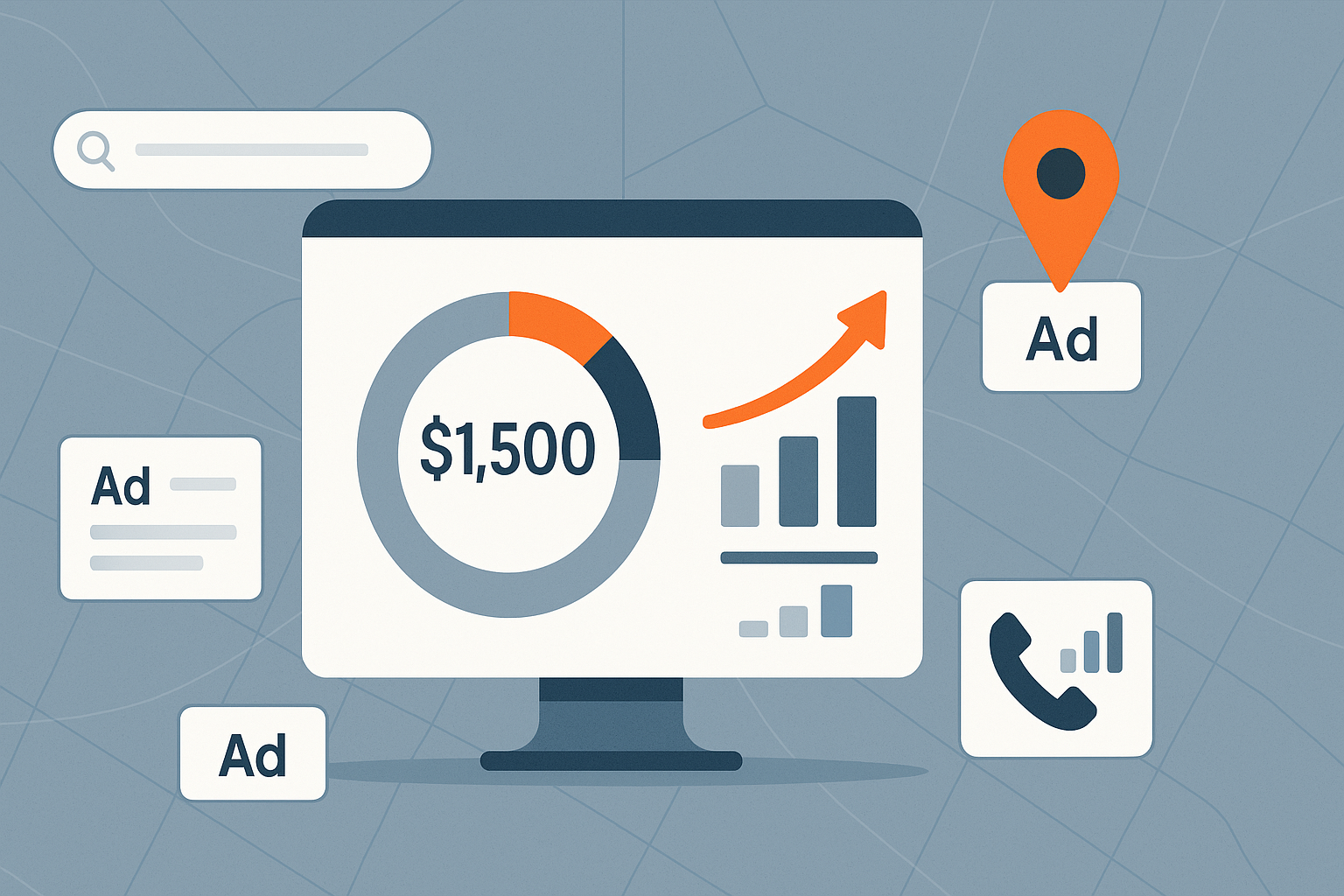
Business owners often ask what a monthly Google Ads budget should actually produce. Before looking at specific numbers, it helps to set expectations. A $1,500 monthly budget is a common starting point for small businesses across the Atlanta area, but the results depend entirely on structure, targeting, and tracking. When the campaign is built correctly, this budget can produce consistent calls and form leads. When it is not, the entire amount can disappear quickly with very little to show for it. The goal is to understand what this budget should deliver once the right system is in place.
1. Predictable Traffic from High-Intent Searches
Your cost per click will depend on your industry and competition. In the Atlanta metro, service businesses commonly see a range that allows a $1,500 budget to generate meaningful click volume. The goal is not to chase the lowest click cost. The goal is to get in front of the right type of customer before they call a competitor.
2. Real Calls and Form Leads
A well-structured campaign, supported by strong tracking, should turn a portion of that traffic into phone calls and quote requests. Service categories like plumbing, electrical, roofing, pest control, and HVAC often see higher call intent, while professional services may see more form submissions. Both are valuable as long as the tracking system can separate real leads from noise.
3. A Reduction in Wasted Spend
This is where many small businesses struggle. Google’s default settings allow your ads to match with broad and sometimes irrelevant searches. A single overlooked term can drain your budget quickly. This is one of the most common reasons business owners believe Google Ads “did not work.”
Strong guardrails, including negative keyword controls, are essential. Most small businesses never build or maintain these controls properly, which leads to waste that goes unnoticed until the budget is gone. This is one of the key areas where expert oversight makes a measurable difference.
4. Service-Area Control
A $1,500 budget should help you learn which neighborhoods, suburbs, or parts of the city produce the best leads. Businesses across Atlanta often discover that certain areas drive higher quality calls or more profitable jobs. Google Ads allows you to shift budget toward the locations that deliver results and away from the ones that do not.
The Tracking System That Makes a $1,500 Budget Work
Google Ads only performs well when proper tracking is in place. That includes:
- call tracking numbers from tools such as CallRail, CallTrackingMetrics, or Nimbata
- GA4 conversions for form leads
- keyword-level performance monitoring
- analysis of first-time callers
- lead quality scoring and revenue attribution
- accurate comparison across LSAs, Maps, and Ads
Most businesses do not fail because of the ads themselves. They fail because they cannot see what is working and what is not. Once proper tracking is set up, wasted spend becomes visible, and real opportunities become easier to scale.
How LSAs, Maps, and Google Ads Work as One System
The strongest local marketing programs use all three channels together:
- LSAs capture customers who are ready to book now
- Maps captures customers looking for nearby providers
- Google Ads captures everything else and opens up new service areas
An electrical contractor in North Atlanta might use LSAs for same-day calls, Maps for nearby visibility, and Google Ads to reach homeowners in growing areas like Alpharetta and Milton. Together, these channels create steady demand instead of seasonal or unpredictable spikes.
What Most Businesses Learn in Their First Month of Google Ads
Once tracking is set up correctly, business owners quickly see:
- which keywords produce real leads
- which service areas drive better job quality
- which ads create higher intent
- how much budget was previously wasted
- how LSAs, Maps, and Ads complement each other
This clarity is what allows businesses to scale confidently. Instead of guessing, they know which parts of the system are generating revenue.
The ROI You Should Expect to See
When tracking is structured correctly, a $1,500 monthly budget gives you a clear picture of your real cost per lead, how much of the budget turned into booked jobs, and which keywords or service areas produced the strongest return. Most small businesses never see this level of clarity, which makes Google Ads feel unpredictable. Once the right system is in place, the numbers become simple to understand and you can make confident decisions about where to spend, what to adjust, and how to scale.
Turn Your Budget into a Predictable Growth System
Most local businesses test Google Ads without the tracking, structure, or controls needed to protect their budget. When that happens, results look inconsistent, and owners assume Google Ads “does not work.” The truth is that Google Ads works well when it is built and managed inside a complete local growth system.
That is the foundation of our Resound Growth Program, which begins with the Free 21-Day Pilot. During the pilot phase, we set up or refine your call tracking, GA4 conversions, service-area targeting, and ad controls so you can see how real leads and real revenue align with your budget. You cover the ad spend, and we handle the setup, testing, and measurement.
If you are an Atlanta-area business owner and want to see how a $1,500 monthly budget should actually perform, apply for the Free 21-Day Pilot today.
